
Why Shared Roadmaps Matter in Decentralised Ecosystems
Direction without control. Coherence without centralisation.

A few framing thoughts before we begin:
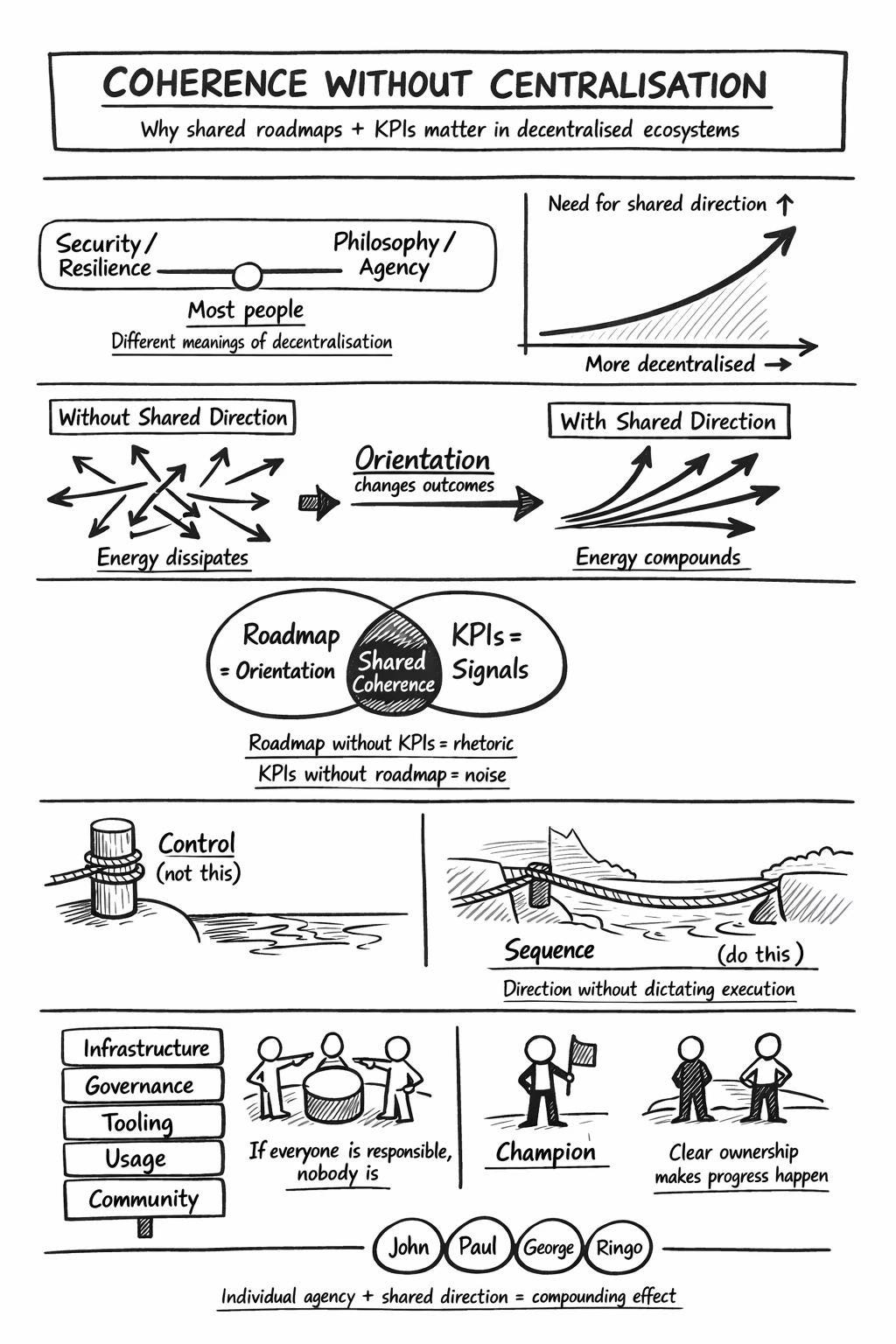
People approach decentralisation from different places. Some for its security and resilience properties, others for what it implies about agency, trust and power.
Most sit somewhere along that spectrum, and move around depending on context.
Shared roadmaps can feel awkward in decentralised systems. Coordination is easily mistaken for control, even when no one is issuing orders.
And yet, at scale, decentralised ecosystems usually need some shared sense of direction if effort is going to compound rather than dissipate or conflict.
Roadmaps and KPIs don’t remove agency. They provide orientation. They set direction and priorities, without dictating execution.
People who care about decentralisation tend to sit on a spectrum.
At one end are the technocrats. Those interested primarily in the security properties. Fewer single points of failure. Stronger guarantees. Systems that degrade and recover gracefully rather than collapse catastrophically.
At the other end are those who believe in decentralisation as lore and philosophy. As a way of organising power, agency and trust. Sticking it to the Man. Less an architectural choice, more a position on how the world ought to work.
Most people who think seriously about decentralisation sit somewhere between those poles, moving around depending on context. Most people, of course, don’t think about it at all. It’s a bit like insurance. Largely invisible. Slightly dull. Very important, but only when you wrap your car around a tree or leave the bathwater running.
This is where roadmaps can start to feel awkward. Not because anyone has failed some philosophical test. Mostly because coordination in decentralised systems can be an acquired taste.
Formal roadmaps have a habit of rubbing up against the decentralised ethos. They can feel suspiciously… directive. Or worse, controlling. Structure is easily mistaken for control, even when no one is actually issuing orders.
And yet, somewhat ironically, decentralised ecosystems need direction more than most.
Shared direction.
Everyone is good at spotting problems to solve. Much less clear is which problems matter most, which should be tackled first, and who is actually accountable for fixing them. Naming a problem is easy. Agreeing which one of us is going to do something about it is harder.
There is a persistent tension between being permissionless and still needing accountability. In practice, when everyone is responsible, nobody really is. Important problems need champions.
I work in the Cardano Web3 ecosystem. After extensive socialisation by the Cardano MBO Intersect’s Product Committee throughout 2025, the Cardano 2030 Vision and Roadmap has, at the time of writing, been validated by a little over 60 percent of DReps and is now awaiting formal Constitutional Committee approval.
Governance mechanics aside, it’s a valuable example of how shared direction tends to emerge in decentralised systems. Slowly. Publicly. And through consent rather than decree.
What’s less often discussed is how direction shows up once control is genuinely distributed.
A community-consented roadmap is one of the quieter ways large ecosystems keep themselves oriented. Not as an instruction manual or a directive, but as a shared point of reference. A way of saying: this is broadly what we think progress looks like, even if we all approach it differently.
At scale, ecosystems generate enormous activity. Builders ship. Communities organise. Tokens move. Governance proposals multiply. Without some shared sense of orientation, none of this is wrong. It’s just hard to read. Energy dissipates rather than compounds.
This is where alignment becomes valuable. A roadmap doesn’t rank every initiative. It makes visible which problems are considered foundational and which are downstream. It groups individual priorities into a more coherent whole and provides a common frame of reference on what matters. That alone changes how decisions get made.
Long-term coherence matters for similar reasons. Budget cycles may, but ecosystems don’t reset annually. Infrastructure choices, governance structures, usage enablers and tooling accumulate. A shared roadmap provides continuity across funding rounds, evolving leadership and shifting conditions. Less a plan. More a sense of sequence. The rope across the river, not around the post.
With an important caveat.
Strategy is always a design under constraint. In Good Strategy, Bad Strategy, Richard Rumelt describes strategy in terms of causal logic. Linked actions. Chains of cause and effect. Strategy is not a checklist or a linear plan. It is a set of choices about what matters, and how actions work together. You don’t fix performance by fixing parts. You fix it by fixing how the system behaves.
Ecosystems are no different. You can think of them in layers, with thematic threads running through them.
This is where shared KPIs sit. Not as targets imposed from above, but as agreed signals of what the ecosystem is paying attention to.
Strategy is a set of choices about what matters. While KPIs are not strategy per se, they reveal and quantify strategy. They make those choices visible, and their outcomes measurable. In highly decentralised systems, KPIs can even become the strategy. Not because numbers are perfect, but because they provide a shared reference point where verbal arguments require interpretation.
You cannot expect (and should not want) everyone to agree on everything. What you can agree on is what success roughly looks like. What is in the common interest. What deserves priority. In that sense, the KPIs often are the strategy, with everything that follows becoming a question of detail, ownership and execution.
Of course, shared ownership of a roadmap is not the same as shared responsibility. A problem shared isn’t always a problem halved. Sometimes it’s just someone else’s ****ing problem. And “someone’s” problem is often delegated to being… no one’s problem.
Vision statements and whitepapers provide meaning and intent. And as I’ve outlined elsewhere through the PRESCIENT framework, shared meaning is essential. But behaviour tends to orient around what actually gets measured, funded, reviewed and discussed. If TVL is the KPI, behaviour will optimise for TVL. If developer retention matters, different trade-offs emerge. If real user activity never appears on the dashboard, it won’t factor into decisions either.
This is why KPIs without an agreed roadmap remain hollow. And why roadmaps without agreed KPIs remain rhetorical. KPIs are where strategy stops being abstract and starts being real.
None of this contradicts decentralisation.
Decentralisation isn’t the absence of structure. It’s the absence of unilateral control. Individual agency matters. It simply operates more effectively when there is a shared sense of how separate efforts relate to one another. You won’t win a rowing race if you are all just splashing your oars.
Now, high-agency people are rightly allergic to bureaucracy and pontification. That’s fine. It takes all sorts. But it is different work.
A shared roadmap provides coherence. And when different (and even disparate) elements cohere, the whole becomes more than the sum of its parts.
John was John. Paul was Paul. George was George. Ringo was Ringo. Together they were, well… the Beatles.
A community-consented roadmap doesn’t tell people what to build. It helps them understand where their efforts might be focused, where their work sits, and how it connects to shared priorities.
And in large ecosystems, that quiet sense-making is often what allows many independent parts to move forward without needing to move in lockstep.
Coherence, without centralisation.