
MONEY IS A COORDINATION TECHNOLOGY THAT HAS BEEN CAPTURED.
Control over monetary affairs is a critical part of genuine sovereignty.

This is a prelude to a five-part series on why the Intelligence Revolution will be decentralised. Before we talk about AI, and the intellectual commons, you need to know what happened when a coordination technology was captured at civilisational scale.
“It is well enough that people of the nation do not understand our banking and monetary system, for if they did, I believe there would be a revolution before tomorrow morning.” - Henry Ford
What is money?
For most of 200,000 years human progress was stagnant, in material and technical terms. Growth was glacial until our ancestors developed the ability to trade with groups of strangers. Objects travelled these networks, and knowledge travelled with them, the object a catalyst, the techniques behind it reverse-engineered at the other end.
Exchange is an interface for ideas, a network acting like a collective brain, allowing specialisation. As Adam Smith argued, the division of labour is limited by the extent of the market. And as Alice Jing Shan argues No Interface, No Entry, without an interface there is no entry to modernity.
Trade cannot exist without trust, and it is difficult to trust strangers. If you want to trade beyond villages, this is a problem you must solve. Trust doesn’t scale. Dunbar’s number suggests a cognitive limit of about 150 people with whom you can maintain stable relationships built on trust and obligation.
So how can humans cooperate at scale? Across borders, across languages, across time?
Money is the solution to this problem. Money is a belief. A meme. An instrument people outsource trust to. It’s an imaginary story. Harari calls it the most successful story ever told. The only story everybody believes. Money is a belief held in superposition across many minds. Money’s value exists only as everyone’s simultaneous belief about everyone else’s belief. You accept the coin because you believe the next stranger will, and they hold the same belief about you. In this way it is a coordination technology. An ingenious tool to allow humans to collaborate and cooperate at scale. Even between strangers. Even between enemies.
“In order to trade, man must first lay down the spear.” - Marcel Mauss
Money can reorganise society because it broadcasts incentives and scales trust exponentially. It is a language for trading value across space and time. And when that language needed more expressive range, McWilliams argues, it invented writing. To track obligations, and only later a medium for stories, prayer, poetry. Which is why the oldest name to survive in written form is a debtor’s. Kushim, on a barley tablet from Uruk, five thousand years ago.
The global monetary system has been captured
The gold standard was ended, and the money printer became a tool for civilisational control and coercion. Fiat, money by decree, became an interface for central planning, redistribution and allocation. An entry point for the modern state to reorganise society.
“Permit me to issue and control the money of a nation, and I care not who makes its laws.” - attributed to Mayer Amschel Rothschild, contested
The Financial Revolution (1688 onwards) built the machinery of central banking, national debt, and credit as state power. But every note in circulation was still an obligation on the issuer, a claim on gold, something scarce that limited the supply. That obligation was withdrawn in stages. In 1933, citizens lost the right to redeem. In 1944, the ‘free’ world was pegged to the dollar, and only nation states could claim the gold behind it. And in 1971, Nixon closed the window on that too. The US could not fund its overseas military while European allies kept demanding gold conversion, and the response was to cancel the debt rather than stop the wars. Each step was sold as temporary. None of it was ever reversed. A ratchet, restructuring the global monetary system.
Ratcheting up ever larger claims to what you own
Since then, money has been conjured from nothing. Those closest to the money printer benefit first, and everyone saving and earning has their purchasing power devalued. The issuer gets to say the new money printed is worth as much as the money you have saved, and so transfers value unseen, without ever touching the notes in your pocket or bank account. For all of your life, the value of your money has decreased. Every year it’s worth less relative to the total supply in circulation, because the total supply has increased but your share has not. Wages rise last, after prices have risen from the new money that’s been created. Currency debasement is counterfeiting, and counterfeiting is fraud, no matter who you are.
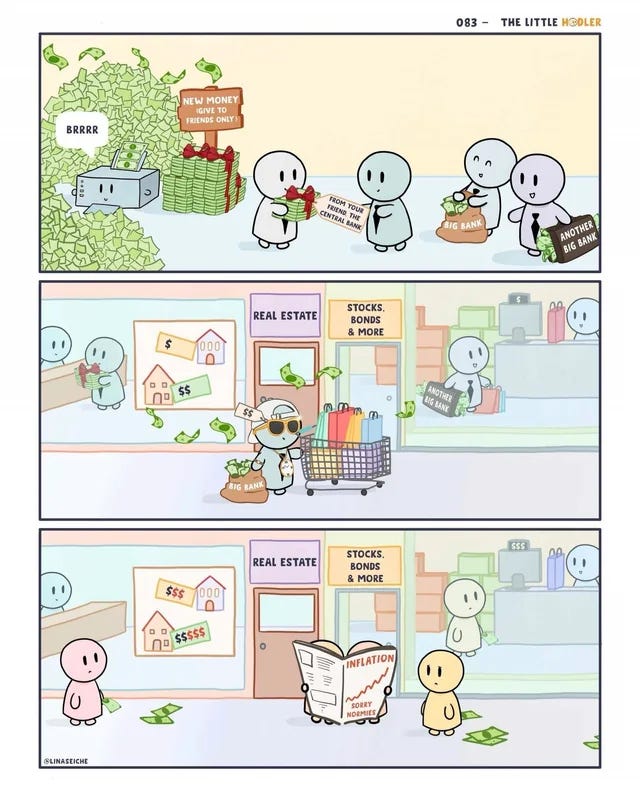
Most money creation happens in commercial banks, through lending, and trickles down through the Cantillon effect. Credit expansion is tidal. Cheap debt floods the market, extended to whoever will take it, so buyers bid more, and the price of a home rises to match, because the supply of houses has not increased. Now you cannot bid higher without taking on debt yourself, and if you will not take it on, you are priced out. Then credit contracts, and the tide goes out. Borrowers can’t service the debt, and the bank takes the house. The loan was conjured from nothing, and the bank risked next to nothing, but the house is real. Then the tide comes back in, and it all begins again.
The purpose of a system is what it does, so boom and bust is a feature, not a bug. It is a wealth transfer, and the contraction is where the transfer happens. Individual banks can die, but the system’s losses are socialised and its gains are private. The transfer is not of fiat, which is infinite and therefore worthless by itself, but of real assets and generational wealth.
Printing creates more money, not more assets, so it rewards asset owners. The poor hold cash and wages, which are what the printing dilutes most. And who holds more assets than the state itself? Granting itself the monopoly to print money. Taxing what you earn, what you make when you invest, what you spend while you live, and what you leave when you die. Future generations priced out of the good life. A home, a family, a future, an inheritance, and encouraged to study for university debt that is simply another tax. You’re being sold into a Davos dystopia of digital serfdom where you will own nothing, and you will be happy.
What you can learn from this is that technology, not ideology, determines the structure of power. Whoever owns the infrastructure controls the incentives which rule everything around you. Sovereignty, the individual’s and the nation’s, is what a captured system takes.
Monetary sovereignty matters more than territorial sovereignty
Wars are waged with credit as much as arms. Merchant banks backed both sides in the Renaissance. Italian city-states ran wars through condottieri, mercenary captains and armies funded on credit, Florentine and Genoese banks financed rival cities, and the Fuggers of Augsburg bought the election of Charles V.
Napoleon fought a war on sound money. Not by choice. Revolutionary France had hyperinflated its paper and defaulted on its debt, so nobody would lend, and he paid for war in coin, tax and plunder. Britain suspended gold in 1797 and fought the entire war on credit, tripling its national debt and bankrolling seven coalitions against him. Credit won, and gold resumed in 1821, after Waterloo.
“The assertion of monetary sovereignty was one of the most powerful instruments in the construction of national unity and state sovereignty.” — François Villeroy de Galhau, Governor of the Banque de France, 2023
Wars are still waged with credit today, even in peacetime. Nations are persuaded by the IMF to surrender their monetary sovereignty. They adopt another currency, or borrow in one someone else can print, under foreign law. Then they default the way a homeowner does. When supply is restricted, US rates rise, its currency falls and the debt can’t be serviced. Real assets are handed over (the ports, the grid, the oil) to keep the lender happy.
Leaders who try to create their own sovereign supply get Gaddafi’d, and those nations are ripe for regime change by ballot or by force. What fiat currency is really backed by is the most powerful military on earth.
“The relevance and importance of territorial versus monetary sovereignty has shifted in favor of the latter. This shift goes hand in hand with the rise of credit-based financial systems. Such systems depend, in the last instance, on backstopping by an entity with control over its own money supply and no binding survival constraints. Only states with monetary sovereignty fit this pattern. All others are de facto more like private entities, which by definition cannot manipulate their own survival constraint. States can surrender their monetary sovereignty directly by adopting another currency or by issuing their own debt in foreign currency and under foreign law. They also compromise their sovereignty by permitting unlimited capital inflows denominated in currencies other than their own. This is because in times of crisis they will not be able to rescue the domestic financial system from its tendency to self-destruct without subjecting itself to a sovereign debt crisis and the implied need to rely on a lifeline from other states or supranational entities.” - Katharina Pistor, From Territorial to Monetary Sovereignty, 2017
Money is a civilisational control system
To the victor go the spoils. Not a pile of gold in Smaug’s lair. The prize is the control system itself. It does not require ownership of the outputs. This is what a coordination technology becomes when it is captured. Standards define what the system can see, input constraints define what can enter, and together they determine what outcomes are possible before anyone acts.
The system doesn’t need to tell you what to do. It decides what there is to choose from. It decides who gets credit, what gets funded, what exists at all. It is an illusion of choice on a grand scale. And a system like this controls the inputs, and the incentives, so it shapes the outputs and what the world can become. Civilisational management, near total control, designed to be invisible to those inside it. Indistinguishable from free exchange.
Credit conjured from nothing is the load-bearing layer. The faces of public governance are short-term populists or unelected bureaucrats. Politicians defer to institutions, institutions to models. Democratic systems that are a misrepresentation of the people. You did not choose this. You never voted it in, and you cannot vote it out. The money supply was never on the ballot.
You were born into it, and you have lived in it your whole life. So will your children, unless something changes. They inherit the bill twice over: the debt itself, and a currency worth less every year. And the bill is never meant to be paid. It is a recoupable advance drawn on future generations’ account, rolled forever, recouped from their time and labour. The only way to escape the debt is endless growth. A bigger economy, a bigger population, so the debt shrinks in relation to both. But the policy is always more debt. You will never be free of it. Engineered dependency, built in incremental steps, each too small to fight. A doom loop.
The machine knows what threatens it.
“The real threat to monetary sovereignty currently lies in the privatisation of money... the biggest risk is payments.” — François Villeroy de Galhau, Governor of the Banque de France, 2023.
And who is the machine? The organisation that claims the monopoly on force, and granted itself the monopoly on money. Not the organisation of production and exchange, but the organisation of the political means. The entity that reorganises society. Moloch is not a state but a supranational network. Peace (UN), health (WHO), development (World Bank), trade (WTO), stability (IMF), and intelligence (Five Eyes). One god, many altars.
AI, like money before it, is a coordination technology that reorganises society. But it sits a layer deeper. Money captured exchange, and through it, governance. AI reaches the layer beneath both: cognition, where belief itself is made. Capture that and everything built on belief comes with it, money included. It is being rapidly deployed by a handful of private companies to capture the 21st Century.
In the next post we’ll talk about whether you’ll be joining the permanent underclass. To be continued…