
Why do some Web3 projects with great technology fade while others flourish?
Introducing PRESCIENT: a framework for sustainable growth in Web3

Ben O’Hanlon and I founded this Substack (all the way back in 2022) to share our experiences, post our thoughts (and take the occasional flight of fancy) as we built communities and ecosystems. 2025 was a year that saw a lot of doing and a lot of thinking. And a bit of writing - I thought I’d share this piece here too.
In 2026, I’ll be writing a lot more. And mostly on here.
Thanks for reading and I would love to hear your views!
In summary:
Success is rarely in the code: The fate & fortune of a Web3 ecosystem is determined by the human and economic fabric around the technology.
A Holistic View: Enduring ecosystems blend hard data and technology with the “softer forces” of narrative, community, and trust.
The Key Differentiator: The path to long-term Web3 success is through trustworthy coordination and measuring success by human connection, recurring participation, and enduring value over short-term hype.
Why do some Web3 projects with brilliant technology fade while others flourish? The answer is rarely in the code. Success comes from the ecosystem; the human and economic fabric that turns a decentralised network into a movement.
The strongest ecosystems blend hard code with human dynamics.They combine measurable on-chain data with the softer forces of narrative and story, excitement and fear, confidence and doubt. Objective reality meets subjective bias. Technical fundamentals meet real-world network dynamics. Metrics like TPS, MAU and TVL are not just numbers. They are surface reflections of deeper forces: product-market fit, clarity of story, trust in leadership, strength of community, and aligned incentives.
These ideas will be familiar to anyone deep in the ether (pun intended) of the Web3 universe. They’ve shaped my own work since I entered the space a decade ago. And my three-week trip to Asia late last year - speaking with founders, builders, investors, community leaders and enthusiasts across the region - reminded me just how much ecosystems depend on the countless individual actions and interdependencies that make them succeed. Or not.
A tangible mental model
So I decided to write some of this down: a framework to connect these disparate, sometimes contradictory, yet deeply linked components into a more satisfying whole. An approachable mental model to navigate the complexity, and a strategic lens to bring focus to tactics.
I’m calling it PRESCIENT. As well as being an apt (and sure, slightly arch) real word, it captures what ecosystems need most: foresight. Recognising what needs to be true today to create the conditions for success tomorrow. A shared language that bridges technical and non-technical stakeholders. A rough-hewn diagnostic to clarify intent and determine action for builders, investors and ecosystem stewards.
A caveat or two before I dive in: it’s fresh. I’m still refining it. PRESCIENT by name, prescient by ambition… there are no great revelations here and those deep in the space will recognise many of these ingredients. Some of it will be obvious. But I’ll take “No sh*t, Sherlock” as a compliment if it means I’ve connected the dots.
Even if creating it has served only to sharpen my own thinking, that alone is worthwhile. But I hope you, the reader, will also find value in it. I welcome your thoughts.
My hope is that PRESCIENT offers a focused, practical lens on a familiar landscape. One that spans both the tangible and intangible, the emergent and the dynamic, reflecting what makes open Web3 ecosystems such fertile, stimulating and challenging places to build.
The Nine Strands of PRESCIENT
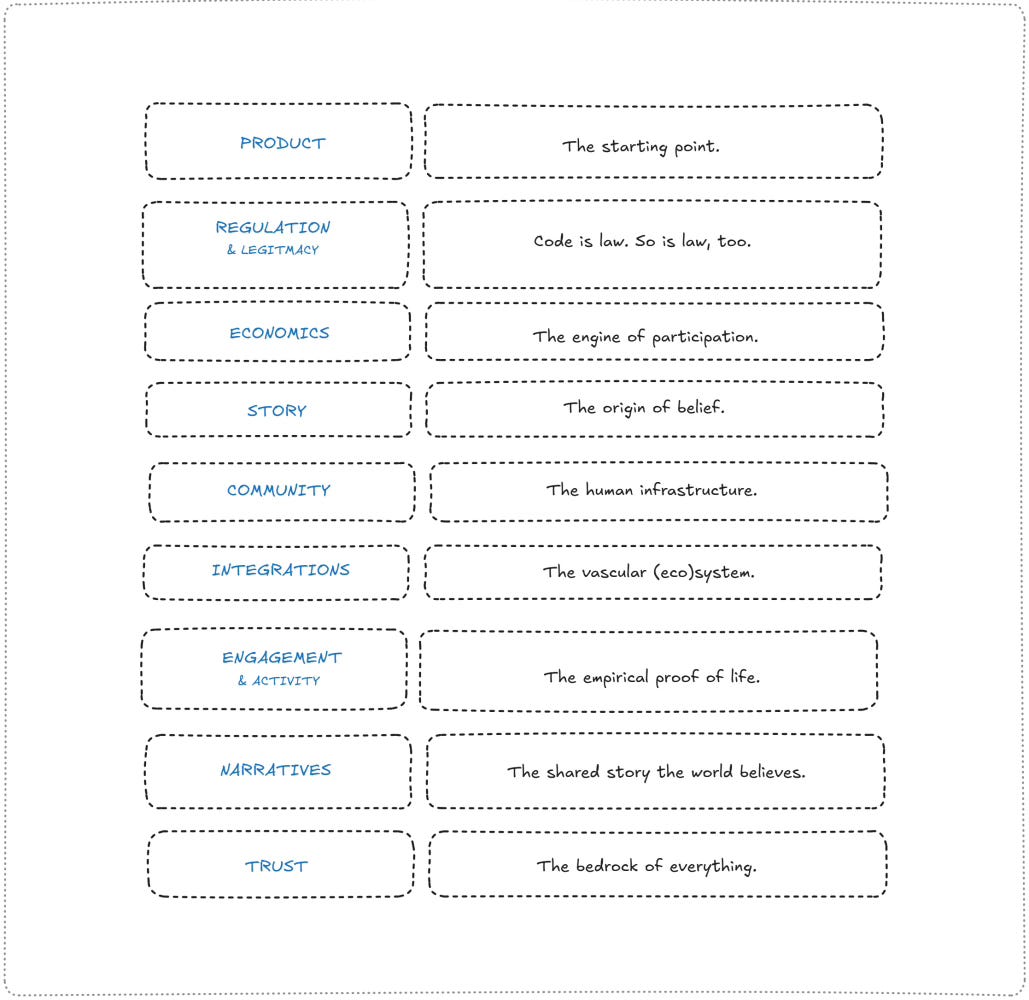
In any complex and emergent ecosystem, the foundations for sustainable growth must be engineered. Each letter in PRESCIENT represents a distinct strand of ecosystem health. Together they form a blueprint for both action and accountability: a way to translate purpose into measurable progress.
P is for Product
The starting point.
Product is the experience users touch and the platform builders rely on. The chain or application must actually work. Fast, reliable, affordable, predictable, and safe. Pick three and build from there.
Product includes user experience and developer experience, wallet flows, API quality, tooling, documentation, uptime, and what you can call “practical trust”: the extent to which the product behaves exactly as users expect.
When something simply works - predictably, consistently, and without ceremony - everything else becomes easier from onboarding to retention. Add a compelling offer, clear incentives and a great product creates its own gravitational pull.
If the product isn’t good, nothing else compounds.
R is for Regulation & Legitimacy
‘Code is law’. So is law, too.
Ecosystems succeed within real jurisdictions, not imagined ones. Regulatory clarity, compliant stablecoins, institutional-grade custody, analytics, identity frameworks, and market-structure legitimacy (e.g., whether an ETF could ever touch your chain) all shape the ceiling of what an ecosystem can become.
Legitimacy is a form of reputation, earned not only through behaviour, but through alignment with evolving global standards and expectations. As Web3 continues to mature, this strand will influence adoption as decisively as the tech itself.
E is for Economics
The engine of participation.
This is the robust tokenomic model and extrinsic incentive structure that attracts and aligns participants, rewards contributions, and ensures long-term sustainability. It’s the airdrops that seed distribution, the rewards functions that drive participation, the liquidity that enables value flow, the on-chain treasury that funds progress.
Incentives are the behavioural primitives of a Web3 ecosystem. They’re the foundational units that shape human action. Just like DeFi primitives define what you can do, incentives shape why you would do it. Good economics drives the behaviour you want; bad economics creates the behaviour you don’t.
Economic architecture should be simple enough to understand and fair enough to trust. It should also reflect the maturity of the ecosystem, recognising that what works early on may not be what sustains it later.
S is for Story
The origin of belief.
The clear and compelling proposition that captures imagination and motivates. A powerful story is simple, purposeful, and easy to retell. It’s your ‘Why’ and gives people context and a reason to believe and to care. A sense-making north star to guide the journey. From an origin story to the tales we tell each other daily, it transforms a technical solution into a shared mission.
A story is what you tell yourself and tell others. You control it. A narrative sits one layer above that: a shared story that gives meaning to events, a way people interpret what’s happening and why it matters. Narratives drive attention, capital, and behaviour long before fundamentals catch up. Stories are yours; narratives are the meta the market already believes and that your stories can help shape. Your story is your house; the narrative is the real estate market.
C is for Community
The human infrastructure.
The living network of customers, users, builders, partners, and advocates who give the project its resilience. A strong community is a defensive moat, a distributed support team, and the most authentic engine for growth. Community is an asset you have; nurture is how you grow it.
Great communities welcome newcomers, retain contributors, and develop their own culture. They create the social fabric that keeps people showing up even when markets turn. They host the emotional energy and informal coordination no roadmap can capture.
But ecosystems are not islands. The strongest communities stay true to their identity while remaining outward-looking: participating in industry conversations, building relationships across chains, and connecting to the wider environment. Communities that look beyond their own walls gain relevance, perspective, and resilience.
A resilient community is not just internally aligned. It is connected, confident, and genuinely engaged.
I is for Integrations
The vascular (eco)system.
The connections that let value, people, and liquidity flow. They operate on two levels; within the ecosystem and across the wider landscape.
Internally, this means composability: dApps, tools, and services that plug into each other cleanly so builders can build faster and users can move frictionlessly. A coherent ecosystem compounds when its parts speak the same language.
Externally, integrations connect the ecosystem to everything beyond it - stablecoins, bridges and cross-chain rails, custody, oracles and the rails that bring in users and capital. These determine whether an ecosystem participates in the broader network economy or stays isolated, liquidity-poor, and hard to onboard into.
With strong composability inside and strong connectivity outside, ecosystems don’t just grow, they accelerate.
E is for Engagement & Activity
The empirical proof of life.
The number of validators running nodes. The consistent developer contributions, application deployments and wallet metrics that demonstrate adoption and product-market fit. The investment in code as much as on-chain usage.
It’s also the level of real engagement in governance driving a project forward.
But activity alone isn’t enough. An ecosystem gains strength when activity isn’t just happening, it’s coherent. And mobilised around what matters most. Even in a decentralised network of autonomous actors, there still needs to be just enough coordination for energy to move in a shared direction. Decentralisation shouldn’t mean disorder; it should mean alignment without hierarchy or gatekeepers. Activity drives performance, and ecosystem-level KPIs are the powerful, unequivocal and objective anchor that removes cognitive load and keeps that alignment clear.
And just as code-level connections shape how value flows, human-level connections shape how effort flows. Engagement matters most when individual contributions interlock, when they compound rather than collide.
N is for Narratives
The shared story the world believes.
We are all creatures of narrative. Narratives move the market and the best projects define their own. Where a story is what you say, a narrative is a cultural current, a compound story the world is already telling. It’s the shared interpretation of what’s happening, what matters, and who is positioned to benefit.
You cannot fully control a narrative. You can only strategically influence, or align with it. But when your narrative resonates with the zeitgeist - the wider mood and momentum shaping the industry - it sings. Whether it’s privacy or real-world tokenisation, financial inclusion or social change, a project that taps into and stakes its claim within the broader market meta amplifies its relevance and its reach far beyond its immediate community.
The strongest ecosystems don’t merely follow narratives; they understand them, align with them, and, at their best, build the cultural momentum that helps shape them.
T is for Trust
The bedrock of everything.
Blockchains may be trustless, but ecosystems aren’t. Trust is earned confidence and belief that a project is worthy, and led by a team that delivers on its promises. It’s as much about founder integrity as it is about network resilience, security audits and transparent roadmaps. It is built through consistent behaviour and reflected in reputation - the collective memory of that trust made visible. It gives users, builders, and investors the conviction to commit for the long term.
In conclusion
Ultimately, PRESCIENT is a mental model, not a magic formula. The world has no shortage of frameworks; an acronym alone builds nothing. Its purpose is to prompt a holistic, honest assessment of an ecosystem’s health.
Too often, projects lean too far in one direction: strong technology but no story; hype without fundamentals; incentives without stickiness; or a disengaged community lacking shared purpose.
Web3’s great differentiator isn’t technology. It’s trustworthy coordination across a decentralised community: systems that are trustless by design, yet trustworthy in practice. PRESCIENT reminds us that success in Web3 isn’t just about code or capital, but about weaving together usage, identity, people, incentives, legitimacy, relevance, and credibility.
The ecosystems that thrive will be those that measure success not by hype cycles, but by human connection, recurring participation, and enduring value. For an ecosystem growth team, viewing their work through PRESCIENT brings clarity. It reveals strengths, exposes blind spots, and sharpens priorities from the top to the bottom of the stack (and more on that soon..).
It also helps answer the essential questions: Are real people really using it? Does the product experience delight? If not, why? Does the story resonate? Are incentives aligned? Do the integrations deliver real value? Is regulation a bridge or a barrier? And where is the next constraint?
Framing strategy through PRESCIENT ensures the focus stays on creating the conditions for long-term success - linking concept to action, action to activity, and activity to meaningful, measurable progress.
This piece was originally published via my LinkedIn.
© Tim Harrison 2025. “PRESCIENT: A Framework for Enduring Ecosystems.” Licensed under Creative Commons CC BY 4.0. https://creativecommons.org/licenses/by/4.0/. Please feel free to remix, build on, or share with attribution.